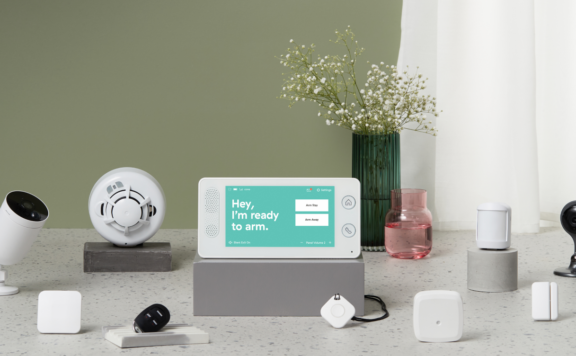
The Abode Outdoor Contact Sensor fills a real equipment gap: most small door and window contacts are designed for indoor frames, not gates, sheds, detached garages, or other openings exposed to rain and dust. Abode’s new model adds an IP66 enclosure, a larger magnet, AbodeRF communication, two AA batteries, and status in the Abode app and supported smart-home platforms.
This is a source-based buyer’s review, not a hands-on endurance test. Specifications and launch pricing were checked against Abode’s live product page and GearBrain’s August 2026 launch guide on August 7, 2026. Long-term battery life, radio performance, adhesive durability, corrosion resistance, and false-alert behavior still need independent field testing. Buyers should verify the live product page, hub support, return terms, and current app behavior before ordering.
Quick verdict
The Outdoor Contact Sensor looks like a sensible Abode add-on for a gate, shed, outdoor storage door, or detached garage where an indoor contact is the wrong fit. Its strongest points are the IP66 rating, a published operating range of -13°F to 140°F, a wider magnet gap, replaceable AA batteries, and direct integration with Abode alarm modes and automations. Its main limits are equally clear: it requires an Abode security system, uses AbodeRF rather than a universal smart-home radio, and has not yet built a long public field record.
| What stands out | Why it matters | What to verify |
|---|---|---|
| IP66 weather rating | Designed for dust and strong water exposure rather than a protected indoor frame | Mounting surface, cable-free water paths, seal condition, and local weather exposure |
| -13°F to 140°F operating range | Covers a wide published temperature band | Your actual surface temperature, sun load, humidity, and winter minimum |
| Stronger magnet and wider gap | Better suited to gates and imperfect outdoor alignment | Maximum supported gap on the exact mounting geometry; the product page does not publish a number |
| AbodeRF/433 MHz | Connects to the Abode system without relying on outdoor Wi-Fi | Compatible hub, real range through walls and metal, and recovery after a missed check-in |
| Two AA batteries | Easy-to-source replaceable power | Expected life under your climate and traffic; Abode does not publish a numeric life on the product page |
| Apple Home, Alexa, and Google Assistant status | Can expose open/closed state to a chosen smart-home interface | Exact hub, account, plan, platform, automation, and notification behavior |
Published specifications
Abode lists the sensor at 3.29 by 2.03 by 0.59 inches. It uses AbodeRF at 433 MHz, runs on two AA batteries, supports operating temperatures from -13°F to 140°F, and lists humidity tolerance up to 85% non-condensing. The enclosure is rated IP66. The box includes the sensor and mounting adhesive; an Abode security system is required.
The product page says the sensor can mount on wood and metal, sends real-time push notifications for open and close events, and lets the owner name the device, choose the alarm modes in which it is active, and choose whether the system chimes. It also says status can be checked through Apple Home, Alexa, or Google Assistant. Those claims describe current advertised behavior, not an independent performance result.
GearBrain’s launch guide adds that the sensor has dual tamper switches and that Abode quotes wireless communication up to 500 feet under optimal conditions. Treat that range as a best-case radio claim, not a placement promise. Exterior walls, foil insulation, masonry, vehicles, metal gates, electrical equipment, foliage, terrain, and hub position can shorten it sharply.
Outdoor Contact Sensor vs Garage Tilt Sensor
Abode launched two perimeter sensors at the same time, but they detect different physical events. The Outdoor Contact Sensor uses a sensor-and-magnet pair to determine whether two aligned parts have separated. The Garage Tilt Sensor measures a change in angle on a moving panel. Pick the mechanism that matches the opening.
| Opening | Better starting point | Reason |
|---|---|---|
| Side gate or garden gate | Outdoor Contact Sensor | Gate and post separate when opened; weather exposure favors the rated outdoor enclosure |
| Shed swing door | Outdoor Contact Sensor | Conventional open/closed geometry if the frame allows stable alignment |
| Sectional overhead garage door | Garage Tilt Sensor | The top panel changes angle as the door travels |
| Tilt-up garage door | Garage Tilt Sensor | Angle change is the defining motion |
| Detached garage side door | Outdoor Contact Sensor | The entry door behaves like a standard hinged opening |
| Sliding outdoor storage door | Outdoor Contact Sensor, after a gap test | Works if the magnet passes cleanly and does not collide or drift |
| Attic hatch or hopper window | Garage Tilt Sensor may fit | Abode markets the tilt model for surfaces that change angle when opened |
The tilt sensor’s live product page lists AbodeRF/433 MHz, a CR123A battery, a 14°F to 113°F operating range, up to 85% non-condensing humidity, and a tilt sensing angle of 40° ±15°. It is not presented as an IP66 outdoor contact. Do not assume the two enclosures have the same weather limits because they launched together.
Where the Outdoor Contact Sensor makes sense
The best use case is an exterior opening with a clear security purpose, stable mounting surfaces, and a repeatable closed position. A side gate that controls access to a backyard, a detached shed with tools, or an outdoor storage enclosure can benefit from a named open/close state before a person reaches the main building.
It is also useful when a standard indoor sensor would be exposed beyond its published environment. “Under an eave” is not the same as indoors: wind-driven rain, dust, insects, condensation, ultraviolet light, and temperature cycling can still reach the device. A purpose-built rating gives the buyer a more defensible starting point, but it does not eliminate installation checks.
A contact sensor is not a lock, barrier, or camera. It reports a change in state. A weak gate latch can open in wind and create alerts; a person can climb a fence without opening the gate; a shed wall can be breached without separating the magnet. Use the sensor as one layer with sound hardware, lighting, safe camera placement where appropriate, and a response plan.
Compatibility: Abode system required
This is not a standalone Bluetooth, Wi-Fi, Zigbee, Z-Wave, or Thread contact sensor. Abode says an Abode security system is required, and the published protocol is AbodeRF/433 MHz. Confirm support for the exact hub model and firmware in your account before buying. “Works with Apple Home” describes an integration path through the Abode system, not direct HomeKit pairing by the sensor.
Also confirm what each platform can do with the exposed state. Viewing an open/closed tile, receiving an Abode push alert, including the sensor in an alarm mode, triggering a CUE automation, and building an Apple Home, Alexa, or Google routine are separate capabilities. Account permissions, notification settings, plans, and platform rules can change the result.
If Apple Home is a primary requirement, compare this launch model with the broader HomeKit side-gate security guide. Test state updates on the actual Home hub and phone before making a smart-home routine part of a safety or security response.
IP66 does not make every installation equal
An IP66 rating generally signals strong protection against dust ingress and powerful water jets under the rating’s test conditions. It does not promise submersion resistance, saltwater durability, protection from every chemical, freeze-thaw survival on every surface, or indefinite life in direct sun. The product page specifically lists humidity up to 85% non-condensing, so a location that traps condensation needs extra scrutiny.
Mount the sensor so water does not pool against seams or battery access points. Avoid irrigation spray where practical, and do not place it where a pressure washer will be used. Keep the device away from a gate’s crush, hinge, wheel, latch, and slam zones. Reinspect after storms, landscaping work, painting, welding, pest treatment, or a gate adjustment.
Metal can help structurally but complicate radio and adhesive behavior. Abode says the sensor is compatible with metal surfaces, yet a large steel gate can still alter real-world range. Temporary placement and range testing matter more than a theoretical distance. For general preparation, see the home-security hub placement guide.
The unnumbered gap is the biggest buying question
Abode describes a powerful magnet that supports a wider gap, but the live product page does not publish a maximum separation distance. That omission matters because outdoor gates rarely close as precisely as indoor doors. Posts move, hinges sag, wood swells, latches wear, and wind can hold a gate a few millimeters away from its usual stop.
Before permanent mounting, measure the smallest and largest closed gap across several cycles and weather conditions. Test the sensor at the worst valid alignment, not the best one. Confirm it reports closed without hand pressure on the gate, then opens reliably when the gate moves only slightly. If the status chatters between open and closed, correct the gate or mounting geometry instead of masking the alerts.
Mounting and adhesive risk
The box includes mounting adhesive. Adhesive performance depends on surface material, paint, powder coating, oxidation, texture, wax, cleaner residue, temperature, cure time, water, and device weight. A weather-rated electronics enclosure can still fail operationally if its adhesive releases.
- Choose sensor and magnet positions outside impact, scraping, and pinch zones.
- Clean only as directed by the sensor and adhesive instructions; let the surface dry fully.
- Temporarily tape the parts and run pairing, range, gap, alarm-mode, and notification tests.
- Mark the validated position before removing the adhesive liner.
- Apply at a temperature and cure time supported by the mounting instructions.
- Add a recurring inspection for lift, movement, cracks, corrosion, water tracks, and alignment.
Do not drill into a gate, fire-rated assembly, electrical enclosure, vehicle, rental property, or shared structure without authority and a safe method. The sensor adhesive mounting guide covers glass, paint, vinyl, metal, removal tests, and lease constraints in more detail.
Radio range: test the full path
GearBrain reports an “up to 500 feet under optimal conditions” Abode claim. That is useful as a ceiling, not a design distance. Test with the gate closed and open, vehicles in their usual positions, exterior doors closed, and the hub in its permanent location. Repeat after dark if landscape lighting, chargers, pumps, or other equipment operates on a schedule.
A successful pairing event does not prove reliable operation. Run at least 20 open/close cycles, confirm every event in the app history available to your account, and watch for delayed or reversed state. Then test after the phone switches from Wi-Fi to mobile data. If the hub or internet goes offline, record which local alarm, chime, history, automation, smart-home status, and remote notification functions continue.
Battery claims need field evidence
The product page promises long battery life and low-battery notifications but does not publish a numeric life estimate for the Outdoor Contact Sensor. GearBrain’s “up to 10-year battery life” statement appears in its Garage Tilt Sensor section, not the outdoor contact section. Do not transfer that number to this product.
Two AA batteries are convenient, but life will vary with temperature, radio conditions, event frequency, check-in behavior, battery chemistry, and alert thresholds. Record the installation date and battery brand, test the low-battery path if Abode provides a supported method, and keep the gate mechanically secure if the sensor goes offline. Never wait for a push alert as the only battery-maintenance control.
Alerts and automations
A useful gate alert names the opening and the condition: “East Side Gate opened while Away” is better than “Sensor 12 changed.” Abode says owners can name the device, select active alarm modes, choose chime behavior, and receive real-time push notifications. GearBrain also describes CUE automations such as turning on outdoor lights after a gate opens.
Start with notification-only rules. After the state proves reliable, add low-risk automation such as lighting. Do not automatically unlock a door, open a garage, disable an alarm, or trigger a dangerous device from one outdoor contact state. Add time, mode, occupancy, and second-signal conditions where the platform allows them.
Use the security alert escalation plan to assign one primary responder, one backup, a response clock, a safe verification method, and a stop condition. More push messages do not equal better security if no one owns the decision.
False-alert risks
Outdoor openings move more than interior frames. Common causes of false or missing alerts include hinge sag, latch bounce, wind, swelling wood, a loose post, magnet misalignment, adhesive movement, a sensor struck by the gate, radio obstruction, low battery, duplicate automation, and a mode configured differently from what the household expects.
When a fault appears, fix the physical or configuration cause. Do not disable every gate notification because one rule is noisy. The false-alarm reduction checklist helps separate placement, power, radio, account, and response problems.
Privacy and shared-user controls
A contact sensor does not record video, but its history can reveal when people enter a yard, use a shed, or leave home. Give household members and contractors separate accounts with the minimum role they need. Remove temporary access on schedule. Check whether an Apple Home, Alexa, or Google integration exposes the state to other people or displays in the home.
A gate sensor should not be used to infer employee attendance, tenant behavior, or child location without a lawful, disclosed policy. Keep names descriptive for response without exposing more personal detail than necessary.
60-minute acceptance test
| Minutes | Test | Pass condition |
|---|---|---|
| 0–10 | Fit and hazard check | Sensor and magnet clear every hinge, latch, wheel, hand, vehicle, and crush path |
| 10–20 | Temporary mount and range | Hub pairs reliably at the final location with doors, vehicles, and normal obstructions present |
| 20–30 | Gap and motion | Ten normal closes report closed without hand pressure; slight opening reports open every time |
| 30–40 | Modes and alerts | Home, Away, Standby, chime, push, and alarm behavior match the written plan |
| 40–50 | Smart-home and automation | Apple Home, Alexa, Google, and CUE show the expected state; low-risk rules run once and stop safely |
| 50–55 | Failure test | Household knows what continues during phone, internet, hub, radio, or battery trouble |
| 55–60 | Record and inspect | Position, battery date, hub, mode, recipients, test result, and next inspection are documented |
Run the test before the adhesive becomes the only mounting reference. Retest after the first rain, a hot day, a cold night, and a week of normal gate use. Then inspect monthly and after any change to the gate or hub.
Who should buy it?
Good fit: an existing Abode household that needs open/closed awareness on an outdoor hinged or sliding opening, can place the sensor within tested AbodeRF range, and is willing to validate mounting and alerts.
Consider another approach: a home without an Abode hub, a submerged or condensation-heavy location, an opening with no stable closed position, a metal enclosure that fails the range test, or a use case that requires a published maximum gap before purchase.
Add another layer: a high-value shed, vehicle gate, pool gate, or remote outbuilding. A contact state alone does not prove identity, intent, latch security, or complete perimeter coverage. Pool and life-safety barriers also have legal and safety requirements that a general security sensor does not replace.
Price and value
Abode listed the Outdoor Contact Sensor at $49.99 when checked on August 7, 2026. GearBrain reported a launch bundle with the Garage Tilt Sensor, but promotions can change or end without notice. Compare the current standalone and bundle price, shipping, plan costs, required hub, batteries, mounting supplies, and any range remediation before judging value.
The product is more expensive than a basic indoor contact sensor, but the correct comparison is a weather-rated, hub-compatible outdoor sensor with tamper and automation support. Paying less for an indoor device used outside can create a shorter service life or an unsupported installation. Paying more is worthwhile only if the exact gate, range, mode, and alert tests pass.
What Abode should clarify
- Publish the maximum supported closed gap and explain how it changes on steel versus wood.
- Name every currently compatible Abode hub and minimum firmware or app version.
- State typical battery life with test conditions instead of only “long lasting.”
- Document dual tamper behavior, including which switch triggers which event and in which modes.
- Explain local, cloud, app-history, chime, alarm, and smart-home behavior during internet and hub-power failures.
- Provide mounting diagrams for inward and outward swing gates, sliding gates, shed doors, and corrugated metal.
- Clarify warranty coverage for outdoor exposure within the published IP, temperature, and humidity limits.
Final assessment
The Abode Outdoor Contact Sensor is a focused addition, not a generic gadget. On paper, it addresses the outdoor problems that indoor contacts avoid: water and dust exposure, larger gaps, temperature swings, and perimeter locations beyond the main building. Abode integration is the reason to buy it and the reason it will not suit everyone.
Our buying stance is positive but conditional. Existing Abode users with a stable gate or shed geometry should shortlist it, then test range, gap, mounting, modes, notifications, and failure behavior before treating it as a security control. The IP66 enclosure and published environmental range are strong starting points. The missing maximum-gap and numeric battery-life specifications keep this from being an unconditional recommendation until independent long-term tests arrive.
Sources
- Abode Outdoor Contact Sensor product page, live specifications and features checked August 7, 2026.
- Abode Garage Tilt Sensor product page, comparison specifications checked August 7, 2026.
- GearBrain: “What You Need to Know Before You Buy Abode Home Security and Its New Outdoor Security Sensors”, accessed August 7, 2026.
FAQ
Does the Abode Outdoor Contact Sensor work without an Abode hub?
No. Abode’s product page says an Abode security system is required. The listed protocol is AbodeRF/433 MHz, so this is not a standalone Wi-Fi or universal contact sensor.
Is the Abode Outdoor Contact Sensor waterproof?
Abode lists an IP66 weatherproof rating and an operating range from -13°F to 140°F. That does not mean the device is designed for submersion or every chemical, condensation, or pressure-washing condition. Follow the live installation and warranty instructions.
Can it monitor a metal gate?
Abode says it is compatible with wood and metal surfaces and uses a stronger magnet for a wider gap. Metal and gate geometry can affect both alignment and radio range, so test temporarily at the final location before permanent mounting.
What batteries does it use?
The live product page lists two AA batteries and low-battery notifications. It does not publish a numeric typical battery life for the Outdoor Contact Sensor, so record the install date and inspect performance through seasonal temperature changes.
Does it work with Apple HomeKit?
Abode markets status checking through Apple Home, Alexa, and Google Assistant. The sensor still requires the Abode system. Confirm the exact hub, platform, account, plan, and automation behavior in the current compatibility documentation.
Should I use the Outdoor Contact Sensor or Garage Tilt Sensor?
Use the contact model where a sensor and magnet separate, such as a gate or shed door. Use the tilt model where the panel changes angle, such as a sectional or tilt-up garage door. Verify the published environmental limits for the exact model.