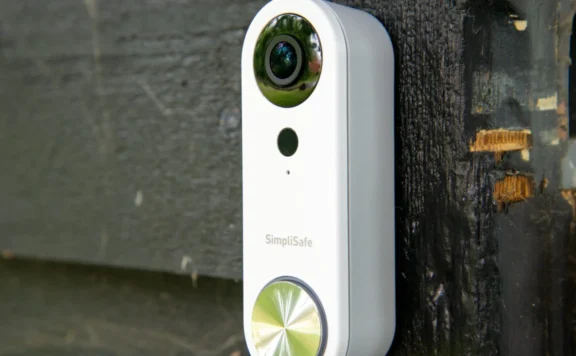
A no-subscription guest-room security setup should answer four questions: which openings are covered, who receives an alert, who can act on it, and what happens when the internet or power fails. It should not turn a bedroom into a surveillance space. For most homes, the right design is a contact sensor on each reachable opening, named access for the guest, and cameras limited to exterior approaches or clearly disclosed common areas.
“No subscription” needs a definition. In this guide it means the owner has chosen not to pay a recurring monitoring or cloud-storage fee. It does not mean every feature works locally, that cellular backup is included, or that an alert reaches emergency services. Check the current feature list before buying and repeat the checks after every app, plan, or internet change.
Guest-room security map: start with the opening, not the brand
| Area | First control | Evidence or response | Privacy boundary |
|---|---|---|---|
| Guest-room window reachable from grade, roof, or balcony | Door/window contact with a clear zone name | Push alert to an accountable adult | No camera aimed into the room |
| Exterior guest-suite door | Contact sensor; add a lock only after fit and egress checks | Named code or credential with an expiry date | Tell the guest what is logged |
| Hallway outside the room | Usually no device is needed | Use a common-area camera only for a defined risk | Disclose placement and audio settings |
| Side path, porch, or detached guest-house approach | Exterior light and weather-rated camera if evidence is needed | Local or cloud recording tested before arrival | Frame the approach, not neighboring windows or private yards |
| Vacant home while the owner is away | Same sensors, different response plan | Local responder or optional professional monitoring | Do not imply self-monitoring calls police |
Three workable no-subscription paths
1. Hub-based alarm path
A hub-based system is useful when the guest room is one zone in a larger alarm. The current Abode Smart Security Kit is one example of a base that can start with self-monitoring and later use an optional plan. Pair each reachable opening with a current Mini Door/Window Sensor. Treat the product and plan pages as the source for today’s included features; do not copy an old price or assume that every automation, history view, storage option, or backup path is free.
2. Platform sensor path
A platform-native contact sensor can work when the household already has a compatible home hub and only needs an opening alert. The current Eve Door & Window page is a useful example. Before buying, confirm the exact hub, phone, operating-system, remote-access, household-sharing, and automation requirements. A standards logo is not proof that remote alerts work during an internet outage.
3. Exterior evidence path
If the risk is the approach rather than the room, put video outside. Abode Cam 2 is one current product path, but the decision is not “which camera has the longest feature list.” Confirm the exact recording destination, retention period, person-sharing controls, subscription boundary, night image, upload time, and behavior after a router or power failure. A live view is not recorded evidence.
Privacy rules for a bedroom or guest suite
- Keep cameras out of sleeping and changing areas. A camera inside a guest room creates a privacy problem that a disclosure does not automatically solve.
- Check audio separately. A camera can record sound even when its view is limited to a common area. Review local law and disable audio when it is not needed.
- Show the guest the controls. Explain the sensor names, arm state, exit delay, locks, cameras, and how to reach the owner.
- Limit shared accounts. Give each adult an individual invitation or code where the product allows it. Do not circulate the owner password.
- Remove access after checkout. Expire temporary codes, revoke app invitations, and confirm that recordings or logs are handled under a written retention rule.
Use the camera shared-user access audit before giving a guest or house sitter video access.
Alert ownership: a phone notification is only the first step
Write one line for each zone: “If this opens while armed, [name] checks [evidence], calls [person], and escalates when [condition].” A second household member should be able to run the plan without guessing. If the first responder is asleep, on a flight, or outside cellular coverage, define the backup person.
For a self-monitored home, use the local responder checklist. Give the responder only the access needed for the job. They should know the address, safe meeting point, alarm disarm method, pet status, and when not to enter. A neighbor is not an emergency service and should not be asked to confront an intruder.
Guest access: choose the smallest useful permission
| Guest need | Safer permission | Remove or review |
|---|---|---|
| Enter through one suite door | One named, temporary lock code | At checkout |
| Disarm on arrival | Individual alarm user or code | At checkout and after any sharing mistake |
| See an exterior camera | Viewer access to that device only | At checkout |
| Receive opening alerts | Only the guest-room zones | When the stay ends |
| Emergency access during an owner absence | Named responder credential stored separately | After each use |
Record who owns every code with the smart-lock access-code audit. Never trade emergency exit for access control: use the smart-lock emergency-egress checklist before relying on a lock at a guest-suite door.
Local storage and evidence checks
“Local storage” can mean a card inside a camera, a recorder elsewhere in the house, or a hub that still depends on an account for playback. Test the exact path. Trigger the exterior camera, wait for the clip, disconnect the internet, and confirm who can retrieve the event. Then restore service and measure how long the system takes to reconnect.
- Set the camera clock and time zone correctly.
- Record the storage location, capacity, overwrite behavior, and replacement interval.
- Export one clip to a second device and confirm it plays.
- Check whether removing or stealing the camera removes the only copy.
- Decide who may view, export, and delete recordings.
- Set a short retention period for routine guest stays unless there is an incident.
Outages and recovery
Run separate tests for power, internet, phone, and account loss. Do not assume a battery icon proves the full alert path survives. A sensor may still report to a hub while the hub cannot reach the owner. A camera may keep recording locally but stop sending a push alert. A smart lock may accept a code while remote management is unavailable.
Document the recovery order: restore power, check the router, confirm the hub or bridge, open the app, test one sensor, test one camera clip, then check every temporary credential. The no-subscription recovery checklist gives a longer handoff sequence.
Guest turnover checklist
- Inspect each door and window for alignment, damage, and a secure latch.
- Trigger every contact sensor and confirm the zone name is understandable.
- Create a named guest credential with an end date; never reuse a code shared by message.
- Check the exit path from inside without an app, phone, or internet connection.
- Show the guest how to arm, disarm, and reach the owner without exposing admin controls.
- Confirm any exterior camera view avoids the bedroom and neighboring private space.
- After checkout, revoke the credential and confirm the event log shows the change.
When optional monitoring is worth comparing
Self-monitoring is a poor fit when nobody can respond reliably, the home is empty for long periods, cellular data at the property is weak, or household members cannot safely manage alarm calls. Compare a paid plan by the exact service it adds: central-station handling, cellular communication, video verification, storage, user count, permit help, and cancellation method. Do not buy from a feature label alone. Confirm the current terms on the vendor page and keep the written offer.
Write the three-year cost before buying
List the hub, sensors, locks, cameras, bridge or home hub, storage cards or recorder, backup power, batteries, installation parts, optional monitoring months, cloud-storage months, replacement hardware, and taxes. Mark every assumption. A “free plan” system can cost more than expected if a required home hub, recorder, or replacement battery was omitted.
60-minute no-subscription guest-room acceptance test
- Minutes 0–10: Walk the property and label each guest-room door, reachable window, exterior approach, and exit route.
- Minutes 10–20: Arm the intended mode. Open each protected opening and confirm the correct phone receives the correct zone name.
- Minutes 20–30: Test the guest credential, expiry rule, inside exit, wrong-code response, and owner recovery method.
- Minutes 30–40: Trigger one exterior video event in daylight and darkness. Retrieve and export the clip. Confirm audio and privacy settings.
- Minutes 40–50: Disconnect the internet. Repeat a sensor event, a lock action, and a camera recording. Write what continues and what stops.
- Minutes 50–60: Restore service, revoke a test user, replace the responder with the backup person, and verify every event appears in the correct log.
Run the broader return-window acceptance checklist while the equipment can still be returned.
Bottom line
The best no-subscription guest-room system is not the one with the most devices. It is the smallest system that covers the actual openings, respects a bedroom’s privacy, assigns each alert to a real person, and produces a known result during an outage. Start sensor-first. Add exterior video only when evidence has a defined job. Compare monitoring when the household cannot provide dependable response.
FAQ
Can a guest-room alarm work without a monthly fee?
Yes, when the chosen devices provide the needed local or self-monitoring features without a paid plan. Confirm current alerts, history, storage, sharing, and outage behavior before purchase because vendors can place different features behind a plan.
Should I put a camera in a guest bedroom?
No. Use contact sensors on doors and reachable windows. If video is needed, place it on an exterior approach or a clearly disclosed common area and check audio, view, access, and retention.
Does no subscription mean the system works without the internet?
No. Some local actions may continue, while remote alerts, app control, or cloud clips stop. Disconnect the internet during the return window and record the exact result.
What is the most important guest-turnover task?
Revoke the departing guest’s individual code or app invitation, then test the next credential and the inside exit path. Do not keep one shared code for every stay.